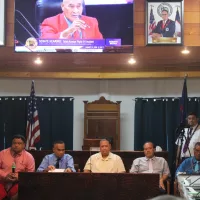
Testimony by airport officials at yesterday’s hearing of the Senate Transportation Committee into the landing incident of Talofa Airways Flight 511 last month, said the pilot did not notify the emergency system that there was a problem.
According to the Assistant Director Airports Division Tavita Fuimaono the Aircraft Rescue and Fire Fighting (ARFF) unit was monitoring the landing at the ARFF station via radio, and the pilot did not give notice that there was an emergency.
Shortly after the Talofa Airways flight, traveling from Faleolo Airport on July 21st, landed at Tafuna, the front wheel broke and the plane slid on its nose on the tarmac before the pilot brought the aircraft to a stop.
The airport fire chief, Vaisa Ulula Simeavao, explained that according to FAA rules, they can only come onto the runway when the pilot gives notice of an emergency. He said once the pilot gives notice, then ARFF can be on standby near the runway. The fire trucks have to respond within 3 minutes, he said, adding that had the pilot given notice of the emergency, they would have been at the site within one minute.
The Chief Pilot and CEO of Talofa Airways Toleafoa Jeffery Hunter told the hearing, the main priority of the pilot for the July 21st flight was the safety of the passengers. He said the pilot brought the aircraft to a stop, shut it down and turned off the electrical system, which meant the radio was turned off, so he couldn’t send notice of what happened through the emergency system.
Hunter said along with FAA in Honolulu and Los Angeles, they are still investigating the cause of the problem that the aircraft encountered that day; but he strongly suspects it was a mechanical failure.
This was the second time that a Talofa Airways plane slid on its nose after landing. Hunter said the first incident happened with a different aircraft.
The committee viewed a TV interview with one of the 8 passengers who were on the flight, who said they waited for 22 minutes on the tarmac before a vehicle picked them up and brought them to the terminal.
Hunter said they viewed airport cameras which showed that their company vehicle was at the scene within 2-3 minutes and the airport fire unit arrived within 6-7 minutes, and this was when the passengers were transported to the terminal.
Senator Magalei Logovii, who was a passenger on the first Talofa Airways plane that experienced a problem with its front wheel, found the explanation from the airport officials unacceptable.
He said regardless of FAA rules, this is American Samoa’s airport, and protecting the lives of passengers was their responsibility.
Magalei said it didn’t make sense that they would wait for notice from the pilot before they responded. He asked what if something happened to the pilot preventing him from notifying you? Do you wait until the plane catches fire and people die before responding?
He related that with the first landing incident, they walked to the terminal before an airport vehicle arrived.
Senate President Tuaolo Manaia Fruean also questioned the logic of waiting for the pilot to give notice of an emergency before responding. He rather the fire unit be on standby near the runway for every landing.
Senator Satele Lili’o directed his questions to the age of the Talofa Airways fleet. CEO and chief pilot Hunter said the aircraft involved in the July 21st landing incident was built in 1978. Talofa has three aircraft flying between the two Samoa and to Tonga. Between the three aircrafts, the airline has 6-8 flights daily on the inter Samoa route. He explained that the aircraft undergo maintenance after 50 flying hours.
Nearly all of the senators present found the response of the airport officials, to the July 21st incident, wanting. They charged that the workers were complacent and even negligent in doing their jobs. Senator Satele said if a tragedy had occurred, it would have been on their heads.
The need for an air traffic control tower for Tafuna Airport was also raised.
Committee Chairman Malaepule Saite Moliga summed up at the end of the hearing that the airport officials can’t say they can not go on the runway unless they are notified by the pilot that there’s an emergency. He said, as soon as an emergency occurred, that’s all the authority they need to respond. He said plans and training are of no use if they are not put into action,


