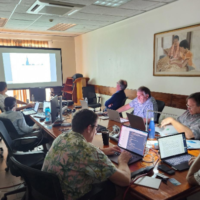
Fish stocks in American Samoa were under review at a meeting at Tradewinds Hotel, over the last seven days.
A team of NOAA scientists from the Pacific Island Fisheries Science Center (PIFSC) presented a draft stock assessment of nine out of eleven federally managed bottomfish management unit species to a panel of reviewers from the Center of Independent Experts (CIE) and Scientific and Statistical Committee of the Western Pacific Fishery Management Council (The Council).
The scientific peer review was conducted at the Tradewinds Hotel from February 17-23. The local fishing community attended the first day of the peer-review and received information about the new assessment.
Several fishermen commented publicly on the importance of getting accurate fishery data and engaging the fishing community on issues affecting their livelihood.
A stock assessment is a scientific report that analyzes available catch, effort, and biological information to determine the bottomfish species’ health and the fishery’s sustainability. This report is the scientific basis for federal fishery management decisions. The last assessment in 2019 showed the bottomfish stock was overfished, and the fishery was experiencing overfishing. The preliminary results of the 2023 stock assessment indicated that bottomfish stock is not overfished, and the fishery is not experiencing overfishing.
Why is the result of the new assessment so different from the previous one?
The previous assessment was a single assessment of the 11 species complex combined.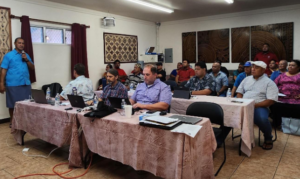
The new draft assessment followed the previous peer review recommendations to split the bottomfish species complex into individual species, and include other data sources.
The new draft assessment has a higher species-level resolution, showing that each species’ catch rates are different. Only some species (e.g. savane, filoa, asoama, and tafauli) exhibited a declining catch rate.
Also, the fishing pressure has been declining since 2015, which helped species to recover.
The expert panel provided their preliminary findings and recommendations to the NOAA scientists on February 23, 2023. Overall, the expert panel’s preliminary conclusions showed that the stock assessment met the terms of reference for the review. They will provide their final reports one month after the review’s conclusion.
The scientists will address the short-term recommendations and finalize the draft stock assessment for presentation to the Council at its 195th meeting in June 2023, in American Samoa.
The scientific peer-review was organized by PIFSC, Council, and the Pacific Islands Regional Office representatives in partnership with the American Samoa Department of Marine and Wildlife Resources (DMWR).
DMWR Director Taotasi Archie Soliai said, “This new draft assessment report that has been confirmed by the independent review panel is great news for the territory and reaffirms our previous position that the bottomfish stock was not overfished and not subject to overfishing as reported in the 2019 stock assessment. The local community, especially the fishermen, were adamant that the previous assessment was not an accurate reflection on the reality that they were experiencing. I am quite ecstatic that the [Western Pacific Stock Assessment Review (WPSAR)] looks positive, given the importance that this fishery has for our local people.”
Soliai commented, “This is the first time ever that the WPSAR review was held here in the territory. It was critically important that the community impacted by these decisions, be part of the review process.”
He thanked PIFSC Fisheries Research and Monitoring Division Director T. Todd for including a local consultation in the process and extended special thanks to the Stock Assessment Team, WESPAC Council and the CIE reviewers, for the hard work they have done to complete the WPSAR review.
“We look forward to the final report being issued in June, and eventually a new annual catch limit being issued next year,” Soliai concluded.


