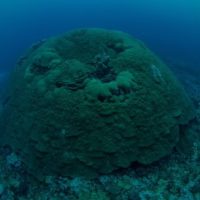
Scientists have discovered one of the world’s largest corals near Ta’u Island.
A team of marine scientists based in American Samoa recently documented a massive Porites coral measuring 22.4 meters across, 8 meters tall (that’s 26 feet tall for my fellow Americans), with a circumference of 69 meters at the base.
This makes it larger than any previously documented corals in American Samoa. Scientists estimate the coral is between 420 and 652 years old.
The coral is located within the National Park of American Samoa. The National Park Service (NPS) is working with the communities of Ta’u to name the massive coral.
This finding is part of an ongoing project coordinated by the American Samoa Coral Reef Advisory Group (CRAG) to catalog and measure all massive Porites colonies around the island.
The team is comprised of scientists from the Department of Marine and Wildlife Resources, National Park of American Samoa and the National Marine Sanctuary of American Samoa.
Georgia Coward, Coral Reef Ecologist with CRAG and lead author of the study said, “Identifying areas where long-lived corals thrive is critical in evaluating changes in climate patterns and evaluating resilience factors that can improve management of coral reef ecosystems in the South Pacific. Due to the large number of these massive colonies, it is evident that the island of Ta’u has ideal conditions that support these resilient corals, and this warrants some level of protection.”
The team made the discovery late last year and also documented 84 individual Porites measuring over 10 meters in diameter and 393 between 6–10 meters.
Their findings have been published in the latest issue of Nature Scientific Reports at nature.com
A second phase of the project will begin in early 2021 and will revisit and measure these corals to determine their rate of growth while also assessing their habitat.


