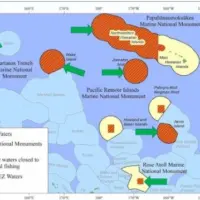
After a full discussion and hearing approximately 70 written and oral public comments at its 206th meeting, the Western Pacific Regional Fishery Management Council took final action to restore commercial fishing in parts of the Pacific Islands Heritage, Rose Atoll, Marianas Trench and Papahānaumokuākea Marine National Monuments.
“This is not about removing monument protections – it’s about restoring sustainable fishing in limited areas under fishery regulations the Council has developed over decades,” said Council Executive Director Kitty Simonds. “Those regulations were built to balance access and conservation, and that remains the Council’s guiding principle under the Magnuson-Stevens Act.”
For the Pacific Islands Heritage Marine National Monument, the Council recommended removing commercial fishing prohibitions to allow commercial fishing within the monument waters from 50 to 200 nautical miles seaward of Jarvis and Wake Islands, and Johnston Atoll. Waters 0 to 50 nm would remain unchanged. The Council also asked the National Marine Fisheries Service to develop a research plan for prioritized electronic monitoring review and observer coverage for trips or sets operating in the area as EM is fully phased into the Hawai‘i and American Samoa longline fleets.
Council Chair Nathan Ilaoa said “In 2009, a large part of American Samoa’s EEZ was closed without consultation, and our people have carried that loss ever since. “This action does not remove the monument; it supports local fishermen, the cannery and the small businesses that depend on a viable fishing economy.”
“This is not a fight between community and commerce or between local values and outside interests, because the families who own and operate these longline vessels are American Samoans,” said Council member Edgar Feliciano. “Opening these waters is not a silver bullet, but it can give a struggling fishery just enough room to survive under some of the most stringent regulations in the Pacific.”
The Council also took final action to restore commercial fishing in other Pacific marine national monuments. Recommended fishing areas to open are 12 to 50 nm at Muliava (Rose Atoll), 0 to 50 nm in the Marianas Trench Islands Unit, and 3 to 200 nm in Papahānaumokuākea for bottomfish and pelagic fisheries only. In Papahānaumokuākea, the 0 to 3 nm closure for all commercial fisheries and longline fishing shoreward of 50 nm would remain prohibited.
Lifting commercial fishing prohibitions would allow fisheries to operate under existing permit, reporting, gear restriction, area closure, catch limit and protected species requirements.
Public comments included both support and opposition for reopening the action areas to commercial fishing. Supporters pointed to continuing cultural fishing practices, food security, fishing access in U.S. waters and benefits for local fishing communities and seafood infrastructure. Several questioned the lack of scientific justification for conservation benefits of the large closed areas in open ocean areas inhabited by highly migratory species. Opponents raised concerns about protected species, ecosystem effects, and the cultural significance of monument areas, especially Papahānaumokuākea.
Referring to the removal of commercial fishing prohibitions in Rose Atoll Marine National Monument, American Samoa Gov. Pulaali‘i Pula said in an August 2025 letter to U.S. Commerce Secretary Lutnick, “This strategic adjustment will provide essential relief and opportunity for American Samoa’s longline fleet, ensuring their continued viability and bolstering the tuna industry that drives our local economy.” David Sakoda, representing the State of Hawai‘i, read into the record Gov. Josh Green’s letter stating, “I urge the Administration to stand firm in upholding the full protections for Papahānaumokuākea and the Pacific Islands Heritage Marine National Monuments.”
The Council’s recommendations for the Pacific Islands Heritage Marine National Monument will be transmitted to NMFS for further consideration through the federal process.


