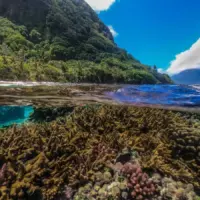
A new $4.6M multi-institute project to help grow coral restoration capacity in American Samoa will begin in early 2026, leveraging more than two decades of coral heat tolerance studies to inform a restoration with resilience approach.
The newly funded coral restoration project, entitled “Resilience-based Coral Reef Restoration and Bleaching Resistant Coral Nursery Design in American Samoa,” will bring together partners from American Samoa Community College, University of Hawaiʻi Sea Grant College Program, American Samoa Department of Marine and Wildlife Resources, University of Hawaiʻi at Mānoa, and Old Dominion University, with local agencies and village leaders to focus on restoring healthy coral reefs and training the next generation of natural resource managers.
American Samoa is fortunate to have some of the healthiest coral reefs within inhabited U.S. waters that are exceptionally heat tolerant, as well as the world’s oldest continuously monitored coral reef transect, making it an excellent coral reef study site. American Samoa has also had the unfortunate distinction of having the highest rate of relative sea-level rise recorded within the NOAA global tide gauge network. Since the fringing reef crests remove up to 97 percent of wave energy before reaching the shore, maintaining healthy reefs is key to protecting the land. Coral restoration, where corals are grown and outplanted onto the reef, is one method of helping reefs recover from impacts such as storms and ship groundings.
Dr. Dan Barshis, a professor of biological sciences from Old Dominion University, and his team have made great progress in understanding the environmental and genetic drivers of heat tolerant corals which ensures some of the corals collected for restoration purposes will be tolerant to heat.
Kelley Anderson Tagarino, Sea Grant College Program extension agent in American Samoa and co-lead on the project, noted “Heat tolerance is key for coral survival due to the increase in marine heatwaves causing mass coral bleaching and coral die-offs. By ensuring some of the corals in our restoration nurseries are heat tolerant, we can help our reefs have a better chance to withstand marine heatwaves. American Samoa has long been known to have highly resilient corals, and now we will be able to weave together local knowledge with Western science to help our reefs continue to protect our islands and feed our people.”
The project also includes funding for three graduate student positions for residents of American Samoa to study coral restoration at either the University of Hawai‘i or Old Dominion University, and will provide support for local positions focused on coral restoration in partnership with the American Samoa Department of Marine and Wildlife Resources.
Dr. Oceana Francis, professor in the University of Hawai‘i at Manoa Department of Civil, Environmental, and Construction Engineering and coastal sustainability faculty with the University of Hawai‘i Sea Grant College Program, will provide critical project support by conducting hydrodynamic modeling (understanding how our ocean water moves) to help identify suitable places for the restoration nurseries, as well as which shorelines are at most risk to flooding. These areas will be prioritized for coral restoration outplanting.
Funding for this project will also support a continuation of the American Samoa Community College (ASCC) Swim and Snorkel program, which trains youth on swim and snorkel techniques, as well as providing basic water safety training. Programs like Swim and Snorkel help empower the next generation of ocean users and reduce barriers to joining projects like coral restoration.
Any interested community members will be invited to join community restoration days during the project.
Questions on the project can be directed to Kelley Anderson Tagarino at at kelleyat@hawaii.edu or 1 (684) 258-2967.
The project was funded by the NOAA Coastal Zone Management program.
Photo: Valentine Vaeoso


