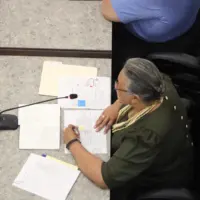
The Department of Education is still short of teachers in both elementary and high schools but Director of Education Maefau Dr Mary Taufetee says the number of vacancies that need to be filled has been reduced from when the new school year started.
Testifying before the House Education Committee on Monday the director said 24 teachers are still needed for the Elementary Division, down from 46 and the number of teachers needed to fill vacancies in high schools is 10, down from 20.
She said some teachers went off island for medical treatment and have not returned. Others have resigned or retired. She assured lawmakers that the department is aggressively seeking teachers to fill the vacancies.
The DOE Director was asked whether teachers who graduated with Bachelor’s and Masters degrees last year have received salary increases commensurate with their degrees. She answered that these teachers must present verification of their degrees before their pay increases can be processed. DOE has budgeted the salary increases in the current fiscal year budget but the teachers must first provide proof of their degrees.
An issue that was raised by Rep Trude Ledoux-Sunia related to overcrowding at the immunization clinics in Fagaalu and Tafuna when schools resumed after the holiday break.
She had reported last week that some parents were sitting on the floor because there must have been 100 students and parents in the clinics, after notices were sent out that students needed to update their immunization shots.
She said there could have been better scheduling to avoid hundreds of students turning up at the clinics for their shots at the same time.
Director of Health Dr Saipale Fuimaono explained that the immunization notices were in response to the outbreak of measles with increasing cases reported from New Zealand and Australia.
Also present at the hearing was the head of the Environmental Health Services Division of DoH Aileen Solaita. She described common conditions found in schools which often lead to the closure of some school buildings.
She cited rat feces in classrooms, unsanitary bathrooms and accumulation of trash in school yards.
Another major problem is termite infestation. And these conditions are not limited to old school buildings. According to Solaita they’re also seeing the same problems in new school buildings. Last year, DoH carried out an initial inspection of schools in March and a list of conditions that needed to be addressed was given to the Department of Education. According to Solaita a follow up inspection in August found that for the most part, no corrective actions were made.
She did praise the School Lunch Program saying that whenever inspections identify problems in school cafeterias, School Lunch Program Manager Christine Fualaau and her staff always respond immediately.
Solaita said most of the conditions that pose a risk to the children’s health and safety are found in classrooms, bathrooms and in the school yards. Not in the cafeterias.


