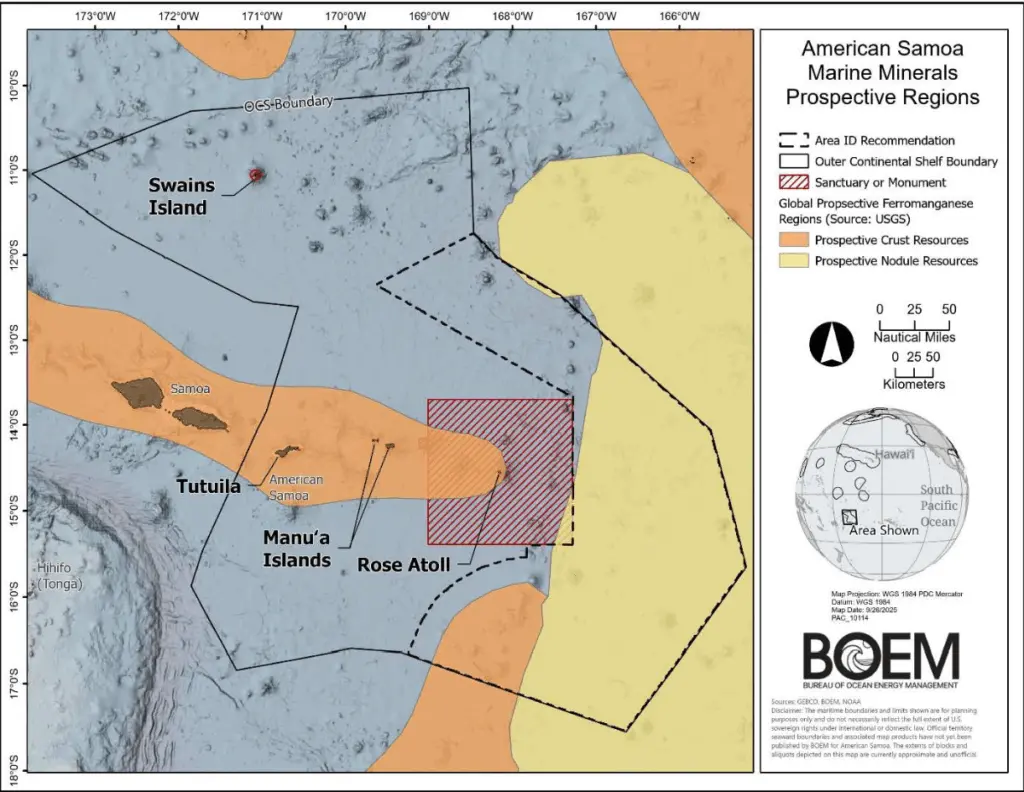
The area identified by the U.S. Bureau of Ocean Energy Management (BOEM) for evaluation of leasing opportunities for critical minerals off shore American Samoa covers about 33 million acres of seabed.
The newly identified area is near the eastern edge of American Samoa’s Exclusive Economic Zone, bordering the Cook Islands, with depths of 1,400 to 6,000 miles.
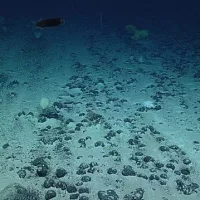
It lies within the Samoa Basin, which contains widespread polymetallic nodules across most of the area, while ferromanganese crusts are concentrated in the southern part of the identified area, as well as in the central parts of the American Samoa EEZ. These deposits are enriched in nickel, cobalt, copper, manganese, and rare earth elements.
The area identification for American Samoa is part of BOEM’s effort to evaluate leasing opportunities for critical minerals on the Pacific Outer Continental Shelf, following an executive order signed in April 2025. The order directs federal agencies to streamline permits for seabed mineral exploration under the Outer Continental Shelf Lands Act (OCSLA) and aims to secure minerals like nickel, cobalt, and manganese to reduce US reliance on foreign suppliers.
According to BOEM, the decision defines which tracts will now undergo environmental review to assess potential economic benefits and environmental impacts of future leasing.
The process was triggered by an unsolicited lease request from Impossible Metals, a U.S.-based deep-sea mining company developing robotic systems to harvest nodules selectively from the seafloor.
Impossible Metals is the first company to request a lease of critical minerals, but it is not the only interested party. During a public consultation in mid-2025, BOEM received multiple indications of industry interest in the region. Feedback supported expanding the original area of interest by roughly 15 million acres (60,700 km2) to the southwest.
In total, BOEM received over 76,000 public comment submissions in response to the Request for Information, including both support and opposition to commercial leasing. Local leaders, including the Governor and Congresswoman of American Samoa, raised concerns about environmental impacts, effects on fisheries and tuna industries, cultural heritage, and Indigenous rights.
BOEM stresses that the Area Identification is not a decision to lease or mine, but the start of a detailed environmental assessment under the National Environmental Policy Act (NEPA). Any future lease sale would require additional public notice and further review.
Source: GeoExPro


