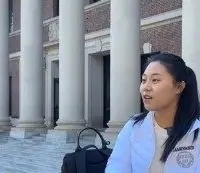
Ameliie Chen, a Pacific Horizons School Alumna and now a freshman at Harvard University, continues to attract national attention with her ground breaking project turning algae into biofuel, a project that she developed in American Samoa.
Featured by CBS News Boston during STEM Week in Massachusetts, Chen is being recognized for her creative approach to renewable energy using resources from the island where she grew up.
“I learned how to turn algae into biofuel in a $7 million lab at UC Berkeley, and that was throughout a summer program in my freshman year [of high school],” Chen said. “And I ended up creating biofuel in my kitchen with no lab.”
Without access to expensive equipment, Chen improvised. She used coconut ash to extract the chemicals she needed, turning a local resource into a key ingredient for innovation.
“I was able to extract potassium iodide from the coconuts and use that to separate the oils from the algal cell parts,” she said.
That creativity earned her national attention. Chen was named a National STEM Champion, joining students from around the country and its territories for their achievements in science, technology, engineering, and math. At Harvard, she’s found a new community of innovators including a fellow National STEM Champion, Rohan Bhosale at MIT, driven by a shared goal to “make the world a better place.”
“It’s a way to say thank you to my island,” said Chen. “American Samoa…it’s a small island in the South Pacific. It’s actually an American territory. We only have 50,000 people living there.”
Growing up there, she saw how rising sea levels and coral bleaching were changing her world.
“Finding another renewable energy source can help fight climate change,” she said. “I think it’s a way to say thank you to my island.”
Now studying environmental engineering and economics, Chen hopes to scale her biofuel project and one day launch her own company focused on algae-based renewable energy.
“Science, it’s a very complex word because it can be used in very good ways. And to me, it’s about using real-world data to make an impact,” she said.


