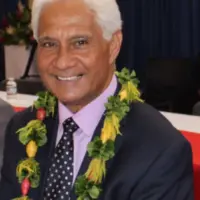
Representative Fagaima Larry Sanitoa is continuing discussions with Hawaiian Airlines on what American Samoa can do to help support a sustainable third weekly flight between Pago Pago and Honolulu.
Fagaima met with Hawaiian Airlines Senior Public Affairs Manager Jacob Aki in Pago Pago on September 1, following Hawaiian’s decision to return the route to twice-weekly service during non-peak periods.
“Rather than simply asking Hawaiian for another flight, I wanted to understand why the third flight was not sustainable and what we can do in American Samoa to help make it work,” Fagaima said.
Following the meeting, Hawaiian provided Fagaima with detailed information on the route. Passenger traffic totaled 59,522 in 2023, increased to 62,444 in 2024, and declined to 59,502 in 2025. Average load factors were 87 percent, 90 percent and 72 percent, respectively.
Hawaiian explained that the third weekly flight, introduced in February 2025, was a test to determine whether the market could support permanent additional service.
The additional capacity did not generate enough new passengers, resulting instead in existing demand being spread among three flights. The airline said three weekly flights continue to work during summer and holiday periods, but demand is weaker during portions of the spring and fall.
Hawaiian also reported that the former Tuesday flight generated approximately 32-percent lower revenue performance than the stronger Monday and Thursday flights.
Hawaiian identified several ways American Samoa could help build demand, including attracting more visitors from Hawaiʻi and the U.S. mainland, taking advantage of Alaska Airlines’ expanded network, coordinating government and group travel, strengthening tourism marketing, and developing additional cargo business.
Fagaima also raised the possibility of using smaller aircraft or a combination of aircraft types to provide three weekly travel days without substantially increasing total seat capacity.
Hawaiian said smaller aircraft could potentially be considered, but that fuel, payload, baggage, cargo capacity and aircraft performance must all be evaluated.
As a follow-up to the September discussions, Fagaima traveled to Honolulu, where Hawaiian Airlines arranged an October 2 visit to its airport operations at Daniel K. Inouye International Airport.
The visit provided an opportunity to continue the dialogue and gain a better understanding of Hawaiian’s operations. “I think Hawaiian has given us a clearer picture of the challenge,” Fagaima said. “The next step is to determine how many additional passengers and how much additional cargo we need during the slower months, and then see what government, tourism and the private sector can do to help build that market.”
Fagaima believes that continued cooperation among Hawaiian Airlines, the American Samoa Visitors Bureau, government agencies and the private sector will be important in developing a practical plan to increase passenger and cargo demand, particularly during slower travel periods.
“I appreciate Hawaiian’s willingness to share its data and work with us,” Fagaima said. “Our goal is not simply more flights. It is more frequent service that can be sustained over the long term.”


