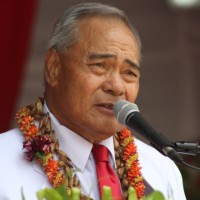
How Lolo Moliga mobilized a people, reshaped a crisis, and built a lasting financial system for American Samoa
By Fuiavailili Keniseli Lafaele
When Bank of Hawaii announced its departure from American Samoa in 2012, it was more than a corporate decision—it was a looming economic rupture. The territory stood at the edge of financial isolation.
When Governor Lolo Matalasi Moliga took office in 2013, he did not inherit a policy challenge. He inherited a crisis.
What followed was not a reaction—it was a masterpiece.
In a quiet room at the Hilton Hawaiian Village in Honolulu, just one hour before a formal proceeding involving the Federal Reserve, Governor Lolo and Congressman Faleomavaega Eni met with Bank of Hawaii leadership.
They did not begin with arguments. They began with identity.
They spoke as sons of the Pacific—of shared ancestry, migration across the ocean, plantation labor, military service, and the enduring bonds between Hawai‘i and Samoa.
They reminded those in the room that this was not just a transaction. It was a relationship.
There were no dry eyes.
And before the formal hearing ever began—the decision had already been made.
Bank of Hawaii would stay.
But that moment did not stand alone. It was part of something far larger.
Governor Lolo understood a truth few leaders fully grasp: To move a powerful institution, you must summon something even more powerful—people.
Across the Pacific and the United States, he activated a network as expansive as it was personal: the Samoan diaspora, churches and faith communities, the University of Hawai‘i, American Samoan law students, nonprofit organizations, the Hawai‘i congressional delegation, Utah allies, and federal officials connected to American Samoa.
This was not lobbying. This was a people’s movement.
Time was bought—but time alone is not a solution.
Under Lolo’s leadership, that time was transformed into action: a new regulatory framework, a new financial structure, and ultimately the creation of the Territorial Bank of American Samoa.
So that when ANZ Bank exited in 2022, there was no crisis—because the system had already been rebuilt.
No masterpiece is created alone.
Governor Lolo’s leadership was supported by the Fono, the Judiciary, the Chamber of Commerce, and the broader community. His core team, led by Iulogologo Joseph Pereira and Fiu John Saelua, included individuals who are no longer with us—Falema’o “Phil” Pili, Afimutasi Gus Hannemann, Steve Watson, and Utu Abe Malae.
Critical backroom support was provided by Treasury, Budget Office, and the Department of Commerce. Legal guidance came from the Attorney General’s Office. Financing support came through the American Samoa Economic Development Authority (ASEDA). Lieutenant Governor Lemanu and the Cabinet stood alongside the Governor—serving, sacrificing, and in some cases, giving of themselves until their final days.
Service at that level was not easy. It was, in many ways, hazardous.
Yet they continued—because they believed in the mission, and in the man who led them.
When the burden grew heavy, Governor Lolo would remind them: “Fa’amalosi mai.” You can do it. Keep going.
Governor Lolo did not govern through division. He appointed leaders based on capacity and character—even those from opposing campaigns.
He saw beyond politics.
He saw people.
At the center of it all was faith.
He often reminded his Cabinet to “sleep light at night,” for that is when ideas come—and when God speaks to guide leaders—o manatu, tofa, ma utaga molipo.
He ensured that American Samoa remained connected to the modern financial system.
He built a lasting institution.
He transformed crisis into resilience.
He brought together government and community.
Strategy and culture.
Policy and faith.
He did not merely hold the line.
He rebuilt it.
And in doing so, he reminded us:
Leadership is not authority.
Leadership is not position.
Leadership is people.
Leadership is faith.
Leadership is service.
And above all—
Leadership is the ability to bring a people together,
to believe together,
and to act—together.


