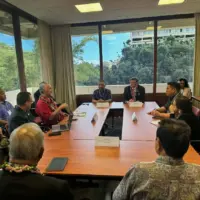
Governor Pulaali’i Nikolao Pula joined the Governors of Guam and the CNMI for a high-level meeting with U.S. Deputy Secretary of State Christopher Landau on Tuesday.
The Governors discussed their roles as strategic American outposts and expressed a firm commitment to partnering with the State Department. Governor Pulaali’i highlighted the territories’ roles as effective ambassadors for the United States, emphasizing that their cultural and geographic ties are essential for strengthening regional stability and fostering shared prosperity across the Pacific.
Prior to a broader discussion with INDOPACOM, the U.S. Department of Commerce International Trade Administration, and the U.S. Department of the Treasury International Affairs, Governor Pulaali’i and ASTCA CEO Folasaitu Sorepa Fata Thomas met with Ms. Shehzi Khan, USINDOPACOM Director of the Joint Interagency Coordination Group, alongside AP Telecom CEO Mr. Eric Handa and Senior Advisor Mr. Joaquin Malavet, a retired U.S. Marine Corps Major General. The leaders focused on specialized training needs and identified areas where AP Telecom can provide technical assistance to American Samoa.
This was followed by a meeting with Sir Michael Jones, General Manager for Matson in Auckland, New Zealand, with follow-on discussions scheduled between March and April to further these logistical and economic initiatives.
Assistant Director for Port Administration in American Samoa, Michael McDonald led American Samoa’s engagement on the critical issues of Deep Sea Minerals (DSM) and regional infrastructure. During the DSM discussions, McDonald focused on a mission of information gathering and fact-finding to ensure the territory remains well-informed of evolving regional developments. He underscored the necessity of a science-based approach to protect the territory’s tuna canning industry and marine environment, while advocating for additional resources—including enhanced support from the Department of the Interior—to expand local education and outreach programs.
This focus on gathering data is intended to ensure the local community is well-equipped with technical expertise and remains at the center of any future deliberations.
McDonald also participated in infrastructure sessions where he highlighted the significant concerns posed by aging WWII-era facilities. He stressed that the current state of American Samoa’s critical port infrastructure, including both the airport and seaport, directly impacts economic stability and social well-being. McDonald urged the need for increased U.S. investment in these hubs, arguing that the territory’s economic resilience is a direct component of a strengthened U.S. national security posture throughout the Pacific region.


