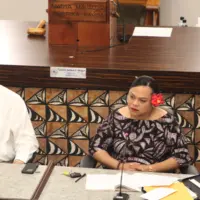
The CEO of the American Samoa Telecommunications Authority, Folasaitu Sorepa Thomas, gave comprehensive testimony on the Google cable project, the status of the Hawaiki and the Samoa American Samoa Cable at a hearing of the Senate Government Operations Committee on Tuesday.
Appearing before the committee with the Governor’s Chief of Staff Leonard Seumanutafa, the CEO elaborated on the genesis of the Google cable for American Samoa, the funding and the benefits it would bring for the territory.
The capacity of the Hawaiki Cable is 200 gigabytes. Of that amount 30 is being used by ASTCA, 10 is used by BlueSky and 10 is used by the Samoa American Samoa (SAS Cable). 150 gigabytes is unused.
Thomas told senator the best way to explain the difference in the speed and capacities of the Hawaiki and Google cables is to think of a highway. Hawaiki Cable has just one lane delivering the 200 gigabytes, whereas the Google cable will have 8 lanes. The advantage would be not just in faster connectivity but there will be dedicated lanes for the government, for business, for schools and for residences.
In comparison, the Hawaiki Cable has all the different se tors sharing the one lane of connectivity.
According to the ASTCA CEO the Google cable was first discussed during the Lemanu and Laapui Administration however no decision was made to implement it as they had to search for a funding source. 
When Governor Pulaalii Nikolao Pula attended a meeting of the National Governors Association early last year, he learned of the Google cable coming to the Pacific. She said the Governor was particularly interested in the educational benefits that the Google cable would bring enabling students to participate in live streams with off island colleges and universities.
Last November the Asia Pacific Internet Development Trust was initiated with a focus on education and research. Thomas said American Samoa, through the Google cable would have a lane dedicated to education.
Because of a Non Disclosure Agreement with Google the CEO said she cannot disclose the total cost of the planned cable. She explained that 35% will be funded with $15 million from ARPA. 25% is to be funded with US Treasury funds that were awarded to American Samoa in 2022 under the Capital Program Fund, which the former administration intended to use for a Technology Park. The funding amount is $14 million and the administration is requesting a reprogramming of that funding for the Google cable. Thomas said they advised Governor Pula that the Technology Park would benefit just a sector of the territory but not everyone. And the funding would be put to better use on the Google cable because we do not have redundancy for internet connectivity, solely relying on the Hawaiki Cable. She referred to what happened in Tonga in 2022 when the kingdom suffered an internet outage for a whole month because it‘s only cable was damaged.
The last 40% is to be covered by the Department of Defense. Thomas said when she was in the US Army, she was assigned to oversee military infrastructure in Guam and saw the amount of funding that the Defense Department spent on infrastructure on Guam. Similarly in Alaska. She said American Samoa’s high per capita rate of military enlistment is often touted but the Department of Defense was not putting any money into building infrastructure on Tutuila and Manu’a.
She helped arrange meetings for Governor Pulaalii and the leadership of the Indo-Pacific at which discussions took place on military funding for the Google cable was discussed. She said the Department of Defense has made a commitment to provide funding.
She said the Defense Department wants to ensure that the cable is secure and if there’s any disruption with connectivity in Guam, they can channel communications through American Samoa.
The Google cable will connect from Hawaii to Tahiti, Fiji and then Guam, with a branching unit to American Samoa.
Thomas said no local funding will be spent on the Google cable.


