Two former lawmakers from the CNMI and American Samoa are calling on the federal government to halt all plans for deep seabed mining near the territories and commercial fishing in protected monuments.
Sheila Babauta, a former representative of the CNMI House of Representatives, and Andra Samoa, a former member of the American Samoa House of Representatives, said in a letter published in Guam’s Pacific Daily News: “As Indigenous leaders from U.S. territories, we stand together against the unilateral decision-making of the federal government threatening the health of our ocean, its ecosystems, and thus our cultures and identities.”
According to their letter, recent actions by the Bureau of Ocean Energy Management (BOEM) and the White House “treat our homes as resource depots for the benefit of corporations and venture capitalists that have no interest in our well-being. Our islands face the specter of federally imposed deep seabed mining. BOEM recently announced the completion of an area identification for critical minerals leasing offshore American Samoa, following a request from the company Impossible Metals.”
The authors say that despite months of opposition from the American Samoan people, a legal moratorium issued by the American Samoa government, and unified opposition from local government, traditional leaders, and more than 76,000 comments “against this destructive commercial activity, BOEM responded by doubling the size of the area under consideration.”
“The CEO of Impossible Metals reveled in the idea that decisions will be made in Washington, D.C., not American Samoa, explaining that in his view there’s a less than 1 percent chance the Trump administration will stop the process, given how enthusiastically the president has embraced mining.
“Now this destructive venture has spread to the Marianas, where we are facing a similar assault. On Nov. 12, 2025, BOEM published a request for information, RFI, regarding mining leases in an area covering over 35 million acres of our ocean—an area the size of New York state.”
The letter says, “As in American Samoa, this process was rushed, opaque, and initiated without the free, prior, and informed consent of the Indigenous people of the Marianas. We were given a mere 30-day comment period to respond to a proposal that could permanently alter our environment—a timeline that our leadership called insufficient for such a complex issue.
“After asking for a 120-day extension, we were only granted 30 days during the holiday season—an incredibly unreasonable timeframe for the education and awareness building needed for informed consent.
“In both territories, the threat to our oceans and communities goes beyond just deep sea mining. Under Executive Order 14276, the federal government is reviewing the Rose Atoll (known to us as Muliava or Nu’u o Manu) and Mariana Trench marine national monuments to determine if they should be opened to industrial fishing.
“Both monuments specifically allow for well-managed traditional Indigenous fishing, noncommercial, sustenance, and recreational fishing, and this action would force our small boat fishermen to compete with industrial scale vessels.
“Yet, the Western Pacific Regional Fishery Management Council, WestPac, is proposing to allow industrial fishing in both monument areas, claiming inaccurately that there will not be major impacts and that most people in our islands support their position.
“We refuse to let our islands serve as sacrifice zones for corporate greed and other unilaterally imposed interests. Through the support of Right to Democracy, we are building a movement to demand agency and power over our lands and waters.”
The letter from the two former lawmakers ends: “We call on the federal government to halt all unilateral plans for deep seabed mining near and commercial fishing in our protected monuments. We urge the United States to recognize a right to democracy and self-determination for the people of all territories.
“We demand a seat at the table, not as subjects of colonial rule, but as stewards of the ocean that sustains us all.”
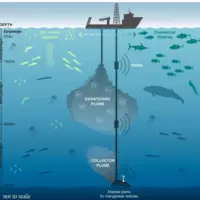
Illustration of how deep sea mining could impact marine ecosystems by Jeff Drazen


