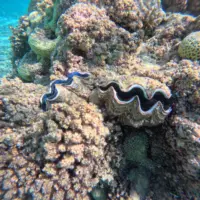
Giant clam populations in American Samoa are more stable and widespread than previously believed, according to new research led by the Hawaiʻi Institute of Marine Biology’s ToBo Lab.
The study found reefs managed by local villages consistently supported higher densities of giant clams and larger individuals than federally designated no-take marine reserves.
Lead author Paolo Marra-Biggs said expectations of population decline were not reflected in the data.
“Many expected that giant clam populations would be in sharp decline, especially near populated islands,” Marra-Biggs said. “Instead, we found that clam abundances have remained relatively stable over the past 30 years, and in some areas have maintained high abundances.”
Marra-Biggs said the strongest results came from areas under Indigenous stewardship.
“The biggest surprise was that village-managed closures outperformed federally protected no-take areas, highlighting the efficacy of cultural stewardship,” he said.
The findings raise questions about current conservation approaches, including a federal proposal to list giant clams under the Endangered Species Act.
Researchers argue broad federal restrictions may undermine systems which are already working in regions with long-standing Indigenous marine management.
Senior author Robert Toonen said clam populations were weakest in areas already subject to strict federal protection.
“The push for ESA listing is supposed to protect giant clams, but our data show that in areas where federal no-take protection already exists, clams populations were among the lowest,” Toonen said. “Instead, areas under traditional Indigenous management had some of the highest densities of giant clams.”
Toonen warned an endangered listing could criminalize effective cultural practices.
“If giant clams were listed as endangered species, these traditional practices that have maintained high clam densities in the region would become illegal,” he said.
The American Samoa Department of Marine and Wildlife Resources said collective stewardship was central to protecting reefs.
“As a community, we can work together to address these challenges,” the department said.
“By promoting sustainable fishing practices, protecting critical habitats, and reducing pollution, we can ensure that our marine resources remain healthy and productive.”
The research was based on territory-wide surveys conducted between 2022 and 2024.
Photo: DMWR


