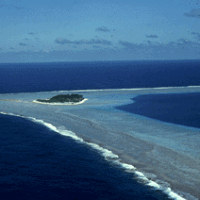
The Director of the Department of Marine and Wildlife Resources, Nathan Ilaoa, supports the reopening of the Rose Atoll Marine National Monument to commercial fishing seaward of 12 nautical miles. The current closure is 50 miles.
In a public comment regarding Presidents Trump’s executive order on Restoring Seafood Competitiveness, Ilaoa said American Samoa is home to a critically important U.S. tuna fishery that supports national food security including the USDA School Lunch Program and U.S. military rations. “However, our America Samoa longline fishery is currently in a state of economic emergency due to a number of factors and the recent federal outreach and regulatory burdens including the expansion of Marine National Monuments in the Pacific Islands Region have disproportionately impacted the fisheries in American Samoa, Hawaii, Guam and the CNMI,” he wrote.
According to the DMWR Director, the current closure of Rose Atoll to commercial fishing is a “costly and inefficient regulation that burdens American Samoa’s fleet without providing significant conservation benefits for the target species.”
He said skipjack and albacore tuna are highly migratory species, and best available science indicates that large static closures like this provide weak to non-existent stock wide conservation benefits for tropical tunas because the fish are highly migratory and not inhabiting the protected areas.
He requested the modification of monument boundaries to allow American Samoa-based commercial vessels, both longline and alia, to fish from 12 to 50 nautical miles offshore. He noted that the 0-12 nautical mile zone is “more than enough ocean area to maintain the current monument protections for coral reefs, seabird populations, and turtle nesting ground[s].”
The DMWR Director explained that American Samoa’s locally owned longline fleet has collapsed from 14 vessels to just 6 active boats due to skyrocketing operating costs and flat fish prices. The closure of nearby fishing grounds like Rose Atoll forces these small vessels to travel further, burning excessive fuel and increasing safety risks, “solely to catch fish without having to transit around the Monument boundary,” he said.
Ilaoa also pointed out that the StarKist cannery, the territory’s primary economic engine, relies on U.S.-caught albacore to fulfill federal contracts for the military and school lunch programs. To keep these contracts, the American Samoa fleet requires Marine Stewardship Council (MSC) certification, which necessitates access to U.S. Exclusive Economic Zone (EEZ) waters.
The DMWR Director stated, “Management decisions must be based on rigorous data rather than optimistic assumptions. Recent scientific critiques of spillover theories demonstrate that even large Marine Protected Areas (MPAs) do not necessarily result in higher catch rates for adjacent fisheries targeting highly migratory species. NOAA should prioritize stock assessment data which currently confirms that American Samoa’s target tuna species are neither overfished nor experiencing overfishing.”
A group of matai from Manu’a is opposing the opening of Rose Atoll to commercial fishing and is asking that the 50-mile closure be maintained.


