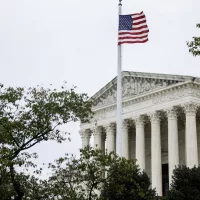
U.S. Supreme Court Justices Neil Gorsuch and Clarence Thomas joined together on Monday to issue a written opinion disputing the view that the “Territories Clause” of the U.S. Constitution provides Congress with “plenary power” over residents of U.S. territories.
The opinion was issued in dissent to the Supreme Court’s decision not to review Veneno v. United States, in which the defendant, Quentin Veneno, Jr., challenged the Court’s 1886 decision in United States v. Kagama and “the constitutional authority [of Congress] to criminalize the conduct of Indians on Indian land.”
Justices Gorsuch and Thomas would have granted review to consider whether “the federal government enjoys ‘plenary power’ over the internal affairs of Native American Tribes.”
Attorney Neil Weare, co-director of Right to Democracy — an organization which works to advance democracy, equity, and self-determination in U.S. territories— said, “The idea that Congress has unrestricted plenary power over U.S. territories is not grounded in the text or history of the U.S. Constitution. But until now the federal government’s reliance on this near-unlimited power has never been questioned by any federal judge, much less a Supreme Court Justice. It is significant to have two Justices now calling into question this unrestrained congressional authority over people in U.S. territories.”
Monday’s opinion critiqued the idea that the Territories Clause might serve as a basis for Congress to criminalize the conduct of Indians on tribal land, stating that “[The Territories Clause” affords Congress only the power to make ‘needful Rules and Regulations’ for ‘Territor[ies] … belonging to the United States.” It then concluded that “[the Territories] Clause, rightly understood,” did not “endow the federal government with plenary power even within the Territories themselves.”
Dr. Adi Martinez Román, co-director of Right to Democracy, said, “People across all five U.S. territories have consistently rejected the exercise of undemocratic, unchecked power over our communities by the federal government. The repudiation of this plenary power by these two conservative Justices is timely as we approach the 250th anniversary of the Declaration of Independence and consider what ‘consent of the governed’ means for people in U.S. territories who have been denied self-determination for over 125 years.”
Weare added, “As concerns about authoritarian rule grow across the United States, these cautionary words about the breathtakingly expansive scope of congressional power over tribal communities and people in U.S. territories deserves more attention.”
Right to Democracy will be convening a panel of legal experts to discuss these important developments later this month.


