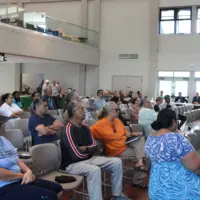
About 50 people attended the community meeting Saturday on the wind farm project at Manunu. Hosted by Tutuila Wind Energy the developer of the project and the American Samoa Power Authority the meeting included lengthy presentations by TWE and WSP, a global engineering and professional services company hired by TWE to conduct environmental and biological studies on the impact of the wind farm project. Among those attending were matai of Auma and Aoloau villages whose lands are included in the project area.
TWE is building a 42-megawatt wind farm and battery storage at Manunu and has entered into a 25-year Power Purchase Agreement with ASPA. The main aim of the project is to reduce greenhouse emissions from the use of diesel and lower the power rate.
Play Audio
Mitsuru Haraoka of TWE. ASPA currently charges 35 cents per kilowatt hour.
At this stage studies and data collection are still being carried out. These include plant and wildlife in the area, noise studies, the visual impact of having 400 ft turbines and archaeological studies. WSP is also looking at endangered snail species found in the area, birds and bats. The location of a proposed access road has been moved because an endangered snail has been found in the area. It was also explained that whereas the initial plan called for 10 turbines to be built, the number has been reduced to six. 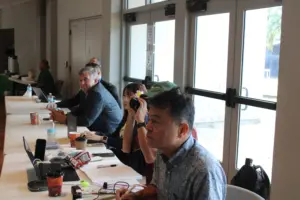
A Met Mast is to be constructed around October or November which would provide valuable data on wind speed, wind direction, temperature, and other parameters. If the wind farm project is a go, construction of the turbines should start in mid 2027. A video showing how the turbines will be transported up to Aoloau was shown during the presentation.
It was explained that land leases have been signed with the village councils of Aoloau and Auma and regular meetings are held with the villages to keep them informed of the progress of the project.
WSP officials Sean Barry and Dr Tim Langer said they’ve liaised closely with DMWR, the Historic Preservation Office, NOAA and other agencies in their local studies.
Andra Samoa, a former executive Director of ASPA and Leone resident was against the project.
Play Audioandra-illegal
Samoa also said that while she was ASPA Director and ASPA was considering a project in Manunu, then Governor Togiola Tulafono advised against this because there was a dispute on the ownership of the land.
Ryan Tuatoo said that land leases have been signed with the village councils of Auma and Aoloau and any land issues should be addressed with the village councils.
Epifania Suafoa of Auma, an archaeologist, said she will support the chiefs of her village.
Ian Gurr raised concerns with the land ownership.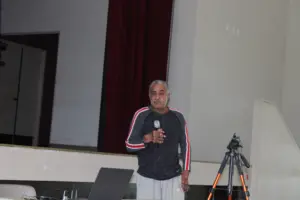
Play Audioisan-gurr
A matai of Aoloau, Logologo Tupulua said that graves of their ancestors were in the Manunu area. He said he did not sign the lease as one of the Aoloau chiefs , and the lease document has a blank next to his name.
Leifi Tama Sotoa said that their company, Green Energy Solutions had signed a power purchase agreement with ASPA for a wind farm at Aasu but due to covid everything was put on hold. He said after Covid, ASPA awarded the PPA for the wind farm to TWE. He said their company had done pertinent studies to site the wind farm at Aasu.
Another speaker was Brian Peck, a former wildlife refuge manager for the US Fish and Wildlife Service.
Play Audiobrian-peck
A young woman from Leone, Natasha, was concerned about the impacts on coral reefs and about water shed protection. Rep Ape Mike Asifoa inquired who would be responsible for the turbines when the wind farm is decommissioned. He said in Hawaii-kai no one is wanting to take responsibility for the wind turbines there after decommissioning. He was supportive of the project but recommended that all aspects be considered thoroughly.
Director of DMWR Nathan Ilaoa thanked ASPA for being transparent about the project. He acknowledged there were concerns about the environment and wildlife but he was happy to hear mitigation plans are in place. He was also thankful that ASPA has involved DMWR’s wildlife biologist in their studies.


