
The decline in American Samoa’s population has serious implications for the territory’s federal grants. This is because many federally funded programs receive formula grants based on population.
At the inaugural meeting of the Statistical Advisory Council, the head of the Statistics Division of the Department of Commerce, Meleisea Vai Filiga, presented the census numbers and what they mean.
The population dropped by nearly 6,000 people between 2010 and 2020. In 2010, there were 55,519 people but in 2020, there were 49,710.
There was also a change in where people lived in 2020 compared t0 2010.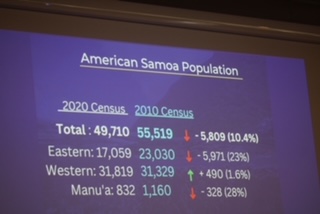
The number of residents in the Eastern District dropped from 23,030 to 17,059.
The Western District population increased by 490 people, from 31,329 in 2010 to 31,819 in 2020.
Manu’a‘s population dropped by 328 people. A total of 1,160 people were counted in Manu’a in 2010 but in 2020 only 832 were recorded.
Another interesting fact in the Census info is the ethnic makeup of American Samoa’s population.
While Samoan is still the dominant ethnicity with 83.2% (41,32) of the population listed as Samoan, the second highest was people of two or more races, at 4.4% (2,192), Filipinos at 3.4% (1,699) and other Pacific islanders at 2.5% (1,219). According to Meleisea, Tongans were second to Samoans in the 2010 Census but in 2020, they comprised only 2.2% (1,093) of the population.


