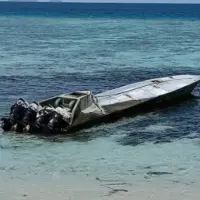
Improved technology is enabling drug networks to adapt and refine tactics to evade detection in Samoa and the Pacific, .
The Samoa Observer reports, Associate Professor and head of the Pacific Regional Security Hub, Macmillan Brown Centre for Pacific Studies at the University of Canterbury, Jose Sousa-Santos said the repeated discovery of “narco-subs” in Pacific waters is an example of this evolution.
This year alone, massive amounts of narcotics, including cocaine and methamphetamine, were nabbed in the Pacific.
Sousa-Santos said that in the Pacific, limited radar coverage beyond coastal areas, constrained maritime patrol capacity, and vast exclusive economic zones create conditions in which these vessels can operate with relative freedom.
“These conditions enable rendezvous operations at sea, staggered transfers (known as drip-feeding), and distributed delivery models. This results in a system designed to exploit the absence of persistent surveillance, rapid response capability, and integrated maritime awareness,” Sousa-Santos said.
He said narcotic-drones reduce legal exposure and complicate questions of attribution, particularly when vessels traverse multiple jurisdictions.
“Even when intercepted, the absence of a human operator introduces ambiguity into both investigation and prosecution.”
For Pacific states, narco-drones present a dual challenge.
The detection and analysis of such systems requires technical capabilities that are often limited or externally dependent.
Existing legal frameworks are not equipped to address autonomous conveyances operating across maritime boundaries.
Sousa-Santos warned that as these drone technologies become cheaper, they will be more accessible.
Aerial drones, while limited in payload, are being used to support trafficking operations through surveillance, coordination, and short-range delivery.
These capabilities are particularly relevant in the Pacific.


